At the conclusion of my first week of work, agonizing because the
beginning of anything newly hard seems all the more interminable, came the
first organized outing of the field school, to Siena. Looking back, Siena might have been the
highlight of my trip for a variety of reasons, which I will get to in a moment,
but I just wanted to preface this entry with that information, so you recognize
the rose-coloured bias in my writing as I wax eloquent.
For beauty and interest in Tuscany, Sienna is rivaled only by the
Tuscan poster child, Florence. It is a brick-built town with almost every street
on a steep gradient winding along the ridges and valleys on which the city
stands. The Campo, it’s main square, is one of the most satisfying urban spaces
ever built, remarkable for it’s fan shape and comfortable slope.
The Campo hosts the Palazzo Publico which was the city hall or
Public Palace and one of the features of the city. It features a gigantic tower
which can be seen from miles around in order to inspire respect and symbolize
power held within the city, emphasized by the intimidating façade and
grotesquely fierce gargoyles featured on the crenulations. Construction began
in 1297 and its original purpose was to house the republican government,
consisting of the Podestà and Council of Nine.
Nearly every major room in the palace contains frescoes. These
frescoes are unusual for the time in that they were commissioned by the
governing body of the city, rather than by the Church or by a religious
fraternity. They are also unusual in that many of them depict secular subjects instead of the religious subjects which are overwhelmingly typical of
Italian art of this era.
The most famous of these frescoes can be found in the Chamber of
Peace (Sala della Pace) as a set of three panels on correct and incorrect
rulership. It was the room used by the Nine (Siena’s form of self-government)
to debate and pass laws, and to govern the city. Commissioned by the city from Ambrogio
Lorenzetti, the fresco, known as the Allegory of Good and Bad Government, was
meant to serve as a reminder to those governing the city of the virtues of
rulership and as a cautionary tale for what happens when power is misused and
perverted. The Allegory is so important,
as is the governing body because of the difficulty faced by all of the city-states;
finding a stable and trustworthy form of Government. Those noble families whose
wealth came from the land scorned those involved with trade, banking, or
manufacturing. Rivalries became linked to wider conflicts between supporters of
the papacy (the Gulephs), and those of the Emperors (the Ghibellines) since
those powers on either side of these small city-states was still strongly felt
so often, it was almost impossible to have an honest governing system untouched
by the rivalries of the wealthy and instead focused on the mutual benefit of
the entire community. As such, the Nine was designed as Siena’s form of
Government and the Allegory was painted on the walls of their chamber to remind
them of the faith and power entrusted to them by the city.
The Allegory of Good Government depicts the personification of
Justice as a woman. She gestures to the scales of balance, held by the
personification of Wisdom floating over her throne. On the viewer's left, a
convicted criminal is beheaded; on the right, figures receive the rewards of
justice. At Justice's feet, the personification of Virtue, also, unusually for
the time, portrayed as a female figure, passes virtue among twenty four
faithfully rendered and recognizable images of prominent male citizens of
Siena. The men face towards the largest figure in the image, a judge located in
the center right. The judge is surrounded by additional personifications
including Peace, who is represented as a fashionable, white-clad contemporary
female figure with elaborate blonde hair.
The allegory carries a strong social message of the value of the
stable republican government of Siena. It combines elements of secular life
with references to the importance of religion in the city at the time. The
figure of Justice resembles the figure of Mary, Queen of Heaven, the patron
saint of Siena, on a throne. The Judge reflects the tradition in the Christian
Last Judgment to have God or Christ judging the saved on the left; the damned
on the right. While classified as medieval or proto (pre)-renaissance art,
these paintings show a transition in thought and an evolution in theme from
earlier religious art.
Flanking the Allegory are two other paintings on perpendicular
walls: Effects of Good Government and Effects of Bad Government. Both these
frescoes depict a recognizable view of Siena and its countryside.
In the allegorical representation of Good Government, the
prosperous townspeople are trading and dancing in the streets. Beyond the city
walls is a lush countryside in which crops are harvested.
In the allegory of Bad Government, crime is rampant and diseased
citizens roam a crumbling city. The countryside suffers from drought.
Many of the frescoes in the Palace, including these, are badly
damaged. This is allegedly due to salt once stored in the basement of the
building. It is theoretically possible that the salts wicked moisture down from
the walls, causing the plaster to dry excessively and the frescoes to flake
off.
Beyond the Palazzo Publico, our group got extremely lucky because
we unwittingly witnessed one of the traditions associated with the Palio, a
horse race whose precedents can be traced all the way back to the middle ages. The
Palio is a race between 10 horses and riders, bareback and dressed in
appropriate colours represent ten of the seventeen contrada or wards of the
city.
On the Friday we were there, we inadvertently witnessed the
selecting of the horses. Set-up at the base of the Palazzo horses owned by the
committee for the palio are paraded before the city and then randomly assigned
to each participating contrada. It is the first step in the process because it
begins the strategizing of the neighborhoods to win, or to cause rival
contradas not to win which is,
unfortunately, sometimes much more important. The neighborhoods come into the
square like a mass of bodies on parade, singing the song of their quarter and
grouping around their selected jockey, making a show of unity and power for the
other contradas. The Horses and Jockeys
are paired and the countdown to the Palio begins.
The air in Siena was vibrant on the Friday we first came to see
the city as excitement over the pairings filled the city, and anticipation for
the race on the following Wednesday and all the Contrada showed their spirit
with flags hung along the street and light fixtures designed to show the
colors and mascots of the specific quarter.
Once we had watched the Selection, most of the Afternoon was gone,
so we grabbed some lunch at a local café, watching the street vendors celebrate
their luck in the horse selection and making predications about the race.

Afterwards, we went to another defining structure of Siena, The Duomo. As discussed earlier, Siena sprang out of the Lombard traffic through the Tuscan region but grew because of it's location on a pilgrimage route between Rome and Canterbury, the Via Francigena. It was a commune and after being freed from it's ties to the Holy Roman Empire in 115 and became a city state, governing itself. Siena's wealth was primarily owed to a few banking families who had made their money at the papal courts. They became economic rivals with Florence as Ghibelline imperialists to Florence's anti-imperial Guleph stance but were unable to compete until the Battle of Montaperti, fought on September 4, 1260 when Siena finally defeated Florence. I tell you all this, some of it again, because it is important to the development of Siena's Duomo, and the city's structures in general. You see, because Siena was in such direct economic competition with Florence, one of the ways they would demonstrate their city's wealth was in the commissioning of large, decadent public structures. The Duomos of the two cities were built in contest, to demonstrate their own superior wealth and culture.


Siena's Duomo (meaning Cathedral) is a
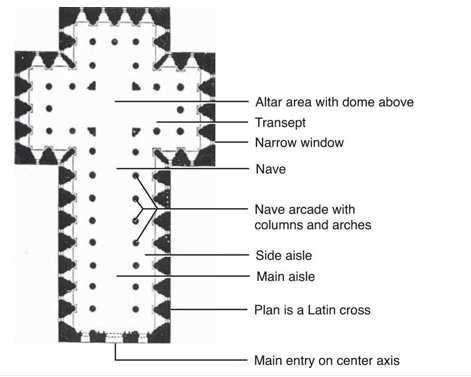
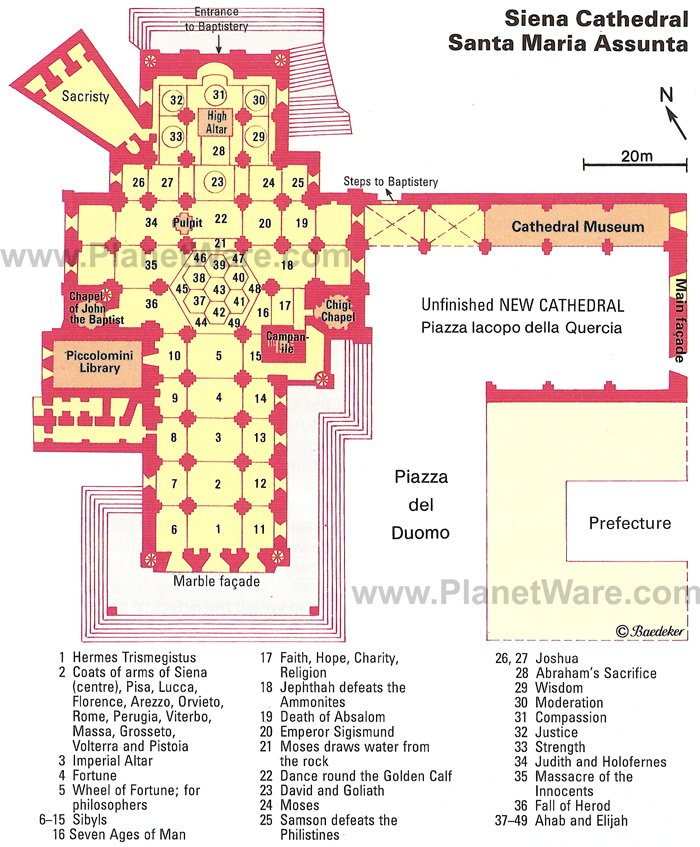
latin cross construction begun in 1215. It is built in striped Black and White marble, which are the colors of Siena, and was originally another church in the 9th or 10th centuries. In 1339, a massive remodel and expansion was planned to double the size of the existing structure and re-orient the church
perpendicular to the extant structure. Construction was stopped by the black death in 1348 and the work was never completed. The floor of the uncompleted nave is not a parking lot and the cathedral Museum and the inside walls and part of a vaulted ceiling can still be seen.
This expansion demonstrates, more than anything, the ambition of the Sienese-primarily in response to Florence's cathedral that was also continually improved upon and updated.
The facade of the structure features three portals, signifying the roman triumphal arches typical of Romanesque era churches and representing the Churches triumph over paganism. It was built in two phases. The first corresponds to the influence of the French Gothic which had gained prominence elsewhere in Europe and was overseen by Giovanni Pisano (Dad,
Nicola Pisano was famous for the pulpits he made, and as one of the leaders of the Renaissance in visual arts). It was designed to emphasize the horizontal elements and was capped with gables and featured a rose window designed by Duccio in 1280 although the existing one dates to 1559. Work on the facade halted in 1317 when they moved to the eastern facade.

The second phase was finished in 1360 under the guidance of a new designer but following most of Giovanni Pisano's original designs. The second phase was more inspired by the elaborate decoration of the Orvieto Cathedral and incorporated several French Gothic elements as well to raise the facade level which was necessary as the nave kept being raised. Pinnacles were added which did not continue from the lower columns causing vertical discontinuity and weakening the structure. this led to the addition of the two towers on the sides to help with structural support. The large mosaics in the Gables were also a later addition, added in 1878 to again, update and enhance the already overwhelming Duomo facade.

In the interior, the black and white continues with 15th and 16th century plaster popes on the moulding and the initial rose window in the choir. The floor of the Duomo is inlaid marble which follows an italian tradition and features 56 panels of Sibyls, oral traditions, allegories of good and bad virtues, and parables.
Of particular interest is a central inlay of a wolf breast feeding Romulus and Remus (Founders of Rome from ancient legend
) According to local legend, Senius and Aschius, sons of Remus and founders of Siena, left Rome with the statue, stolen from the temple of Apollo in Rome. The image has become representative of Siena as a whole.

Another
notable feature of the Duomo is it's pulpit, carved by the designer's father,
Nicola Pisano. The pulpit itself is octagonal and it has a central column on a
pedestal that is encircled with the carved figures of ‘Philosophy’ and the
‘Seven Liberal Arts’. There are eight outer columns made of granite, porphyry
and green marble that are “supported alternately, like the Pisa pulpit on flat
bases and lions. On the Panels, there are carved reliefs that “represent a Christological cycle from the Visitation to the Last Judgment. An aspect of
these panels is that each one shows more than one subject, whereas, the Last
Judgment is told in the space of two reliefs. The panels of this monumental
pulpit share the same compression style of the Late Antique and Roman
sarcophagi. In between each of the panels on the corner sections Nicola chose
to include Christian symbols to help make the story line of the panels to flow
more effortlessly.


Also
worthy of note, the Piccolomini Library, a collection of Manuscripts and
illuminated choir books displayed in a room vibrant with Medieval Fresco on
every surface.
The visual impact of these very colourful frescoes is stunning.
The frescoes tell the story of the life of Siena's favourite son, cardinal Enea
Silvio Piccolomini, who eventually became Pope Pius II. He was the uncle of
cardinal Francesco Todeschini Piccolomini (then archbishop of Siena and the
future pope Pius III), who commissioned this library in 1492 as a repository of
the books and the manuscript collection of his uncle. The ceiling is covered
with painted panels of mythological subjects. They were executed between 1502
and 1503 by Pinturicchio and his assistants.

The
entrance is a finely carved marble monument with two openings with round
arches, executed in 1497 by Lorenzo di Mariano. It contains a round relief of
St. John the Evangelist (probably) by Giovanni di Stefano and, below the altar,
a polychrome Pietà by the sculptor Alberto di Betto da Assisi in 1421. Above
this marble monument is a fresco of the Papal Coronation of Pius III by
Pinturicchio in 1504. In the
middle of the library is the famous statue Three Graces, a Roman copy of a
Greek original.
Pinturicchio
painted this cycle of frescoes around the library between 1502 and 1507,
representing Raphael and himself in several of them. This masterpiece is full
of striking detail and vivacious colours.